Spray foam guide
Is spray foam insulation bad?
Sometimes, though not always. Whether spray foam causes problems depends on the type of foam, what it was sprayed onto, how the roof is ventilated and the state of the roof covering. Here's what the research and professional bodies say, and how to decide what to do.
Written and reviewed by the Roof Insulation Solutions team. Sources checked 25 November 2026.
The evidence
What does the government research say about spray foam?
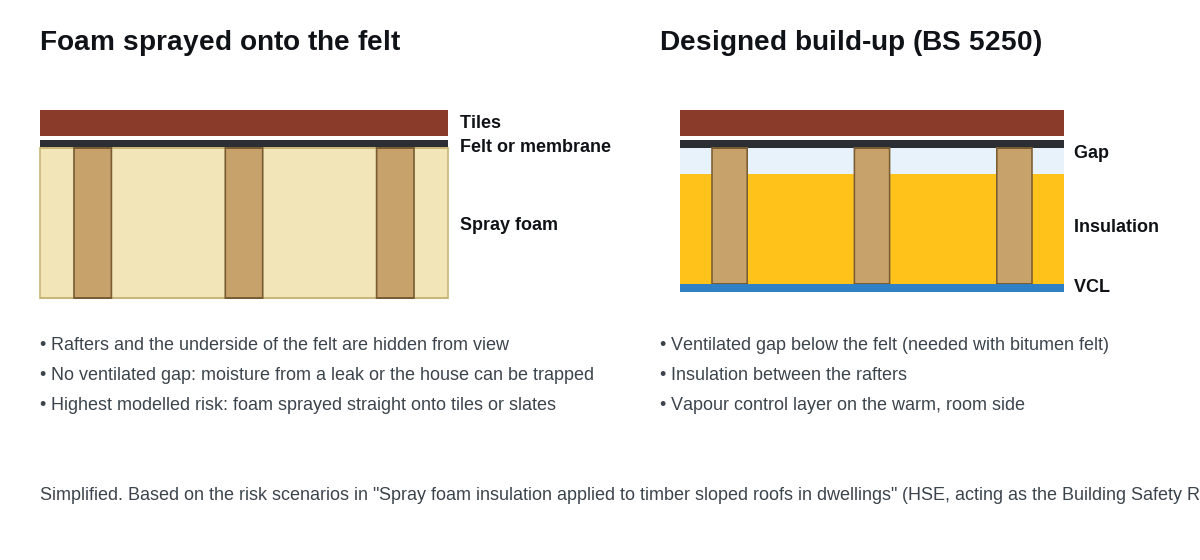
The HSE report on spray foam in sloped roofs (dated February 2024, published 28 March 2024) rated moisture risk from low to high depending on how the foam was fitted. Open-cell foam built to the BS 5250:2021 design was low risk. Foam sprayed directly onto tiles or slates was high risk in every scenario, meaning over 25% predicted timber decay in five years.
The government research says spray foam is a problem when it is fitted the wrong way for the roof, and much less of one when it follows the British Standard design.
The report, Spray foam insulation applied to timber sloped roofs in dwellings, was started by the Department for Levelling Up, Housing and Communities and completed by the Health and Safety Executive acting as the Building Safety Regulator. The report is dated February 2024 and was published on GOV.UK on 28 March 2024. It models timber decay over five years in London and colder Newcastle climates, so it shows theoretical risk rather than findings from real lofts. Headline results from its executive summary are below. High risk means more than 25% predicted decay in the outer timber over five years, medium 1% to 25% and low under 1%.
| What the foam was sprayed onto | London climate | Newcastle climate |
|---|---|---|
| Open-cell foam built to BS 5250:2021 (vapour control layer plus a gap behind the foam) | Low risk | Low risk |
| Directly onto a low resistance (breathable) underlay | Low risk in all scenarios | Medium risk, or low with closed-cell foam and a vapour control layer |
| Directly onto a high resistance underlay, such as bitumen felt | High risk for open-cell foam with no vapour control layer, otherwise low | High risk, reduced to medium or low with a vapour control layer |
| Directly onto tiles or slates | High risk in all scenarios | High risk in all scenarios |
The report also found that leaks through a damaged roof covering, and small gaps between the foam and the rafters, increased the risk of condensation collecting on the cold side of the foam, and that these risks were likely to be highest with closed-cell foam. Extra moisture from the house, such as through ceiling cracks or an unvented bathroom, raised the risk of condensation and mould. If you're not sure which type of foam you have, our guide to open-cell vs closed-cell spray foam explains how to tell.
The law
Is spray foam insulation banned in the UK?
No. We found no UK ban on spray foam insulation. Official guidance sets out how it should be specified and installed rather than prohibiting it. The exception is listed and protected buildings, where consent is needed first and RICS says it is unlikely to be given.
Trading Standards guidance for installers on Business Companion says moisture plans should follow BS 5250:2021 and "a product with BBA or Kiwa certification is considered compliant with building regulations". Cornwall Council Trading Standards (updated November 2026) says spray foam "can be effective when correctly designed and installed for a suitable property" but "is not appropriate in all cases".
- Must meet the Building Regulations and BS 5250:2021 moisture guidance
- Listed buildings need consent before any spray foam goes in
- Lenders and surveyors set their own policies, covered in our spray foam and mortgages guide
The numbers
How many homes with spray foam have problems?
A minority, though not a small one. In a January 2025 poll of 12,476 UK adults for Citizens Advice, 33% of people with spray foam in their loft said they had experienced at least one issue with it. A May 2025 Property Care Association survey found defects caused by spray foam in 35% of the homes its specialist surveyors inspected.
- 33%
Citizens Advice poll: one in three report an issue
Citizens Advice's report A Foamidable Challenge (June 2025) found 33% of people with loft spray foam reported a problem. These are self-reported answers, and the same report says that for most people the foam "will have been installed correctly and will be appropriate for the property".
- 38%
Citizens Advice: problems selling or remortgaging
Of the homeowners in that poll who had issues, 38% had problems selling, remortgaging or releasing equity. Spray foam complaints to the Citizens Advice consumer service more than doubled in 2024 compared with 2023.
- 35%
PCA survey: defects found at inspection
The Property Care Association's survey, run with the HomeOwners Alliance, found one or more defects caused by spray foam in 35% of homes inspected, as reported by The Negotiator (21 May 2025).
- 27%
PCA survey: major works recommended
Surveyors recommended major works, either replacing the insulation or re-roofing, in 27% of cases (Mortgage Solutions, 20 May 2025).
Treat the PCA figure with care. It comes from a limited set of homes that specialist spray foam surveyors were asked to inspect, so it is a self-selected sample rather than a picture of every home with spray foam.
Why people remove it
What problems can spray foam cause in a loft?
Spray foam can seal moisture into a roof, hide timbers and leaks from view, and make surveys and lending harder. Citizens Advice's 2025 report lists damp, timber damage and ventilation failures among the problems people describe. These risks apply most where the foam was fitted without the right design for that roof.
The problems with spray foam come from trapped moisture and what the foam hides, and both are worst where it was fitted without a proper design.
Can mould grow behind spray foam?
It can. The RICS consumer guide (March 2023) says foam "will also seal in moisture unless adequate precautions are taken", and that timbers can look dry on the visible surface but be wet behind the foam. Which? (October 2026) warns of condensation that "can lead to rot in the roof timbers, which can go undetected for many years".
Leaks hidden behind spray foam
The Property Care Association says spray foam "completely obscures the underlying roof structure", so a leak behind it may not be seen. RICS adds that if you already have foam, "you may not see a problem developing until it is too late".
Is spray foam safe?
RICS notes that polyurethane spray foam is a combustible material, typically rated Class E, and would increase the likelihood and extent of damage if a fire started. Which? lists harmful fumes during installation among its drawbacks. RICS also advises checking that your home insurance allows it. Our guide to spray foam and home insurance explains what to tell your insurer.
Spray foam, surveys and mortgages
RICS says a surveyor who finds spray foam may ask for an independent specialist report, and that could affect their opinion of value. Earlier research by the HomeOwners Alliance and the BBC found that some large lenders would not lend where spray foam had been retrofitted, and no equity release providers would. We cover it in our mortgage and selling guide.
What to look for
Signs worth checking in a loft with spray foam
Spray foam can hide what's behind it, so a clean-looking loft doesn't prove the roof is dry. The signs below come from the research and guidance above. None proves there's a problem, but each is a good reason to have the roof looked at by someone independent.
If you'd like a first opinion, send us one or two photos taken from the loft hatch and we'll tell you what we can and can't see from them.

- Damp patches, condensation or mould in the loft or on the ceilings below. RICS and Which? both link badly fitted foam to condensation and damp.
- Foam sprayed directly onto the back of tiles or slates with no membrane. The 2024 research found this high risk in every scenario, and RICS says most products should not be applied this way.
- Foam on bitumen felt or a non-breathable plastic underlay with no vapour control layer, which the research rated high risk in several scenarios.
- Gaps or cracks between the foam and the rafters, or foam that is crumbling or has shrunk. The research found gaps raised condensation risk, and a 2020 RICS journal article links crumbling and shrinkage to poor mixing or application.
- Slipped or broken tiles, or foam used to glue a failing roof together. RICS says such roofs are often due for replacement.
- A survey or valuation that flags the foam or asks for a specialist report.
- No paperwork. RICS recommends keeping the installer's calculations, photos, warranty and any BBA or Kiwa certificate.
Decision guide
Does spray foam need removing?
Not always. Trading Standards says "some installations do not require removal", and the HSE report modelled open-cell foam built to BS 5250:2021 as low risk, under 1% predicted timber decay. Whether yours needs removing depends on what's under the foam, and an independent inspection is the safest way to find out before you commit.
- First
Get an independent assessment
Trading Standards advises an inspection by "a qualified independent surveyor with experience in spray foam insulation". Do this if you're selling, see any of the signs above, or are told it must come out.
- Often removed
When removal is usually considered
Foam sprayed directly onto tiles or slates, foam used to hold a failing roof together, or an inspection that finds damp or decay. These match the highest risks in the research and guidance.
- Often kept
When leaving it may be reasonable
Open-cell foam installed to the BS 5250:2021 design, which the 2024 research modelled as low risk. RICS also notes its guide doesn't cover foam that was part of a new build or a designed loft conversion.
- Always
Don't decide under pressure
Get the report in writing, check your lender's view and compare quotes using our removal cost guide.
Weighing it up
Spray foam insulation pros and cons
Spray foam does insulate well for its thickness and can reach awkward spaces. Against that, RICS and Which? point to moisture risk, hidden defects, fire performance, cost and lending difficulties. Which?'s view in October 2026 was that for most homes "the potential risks are likely to outweigh the rewards".
| Pros (per RICS and Which?) | Cons (per RICS and Which?) |
|---|---|
| Better insulator than the same thickness of mineral wool | Can seal moisture into the roof if not designed for it |
| Sprayed on, so it suits unusual shapes and tight spaces | Hides timbers and leaks from view |
| Open-cell foam lets moisture through, so condensation is less likely | Combustible, typically Class E |
| Closed-cell foam is generally the better insulator | Hard to remove, and can affect surveys, value and lending |
RICS notes that topping up ordinary loft insulation at ceiling level is likely to be much cheaper than spray foam. If your foam does come out, our guide to what goes back in after spray foam removal covers the inspection and the choices, and our sheep's wool and multifoil pages look at two of the options in detail.
Be careful
Why are people being told their spray foam must come out?
Some removal advice is genuine, and some is pressure selling. Citizens Advice (June 2025) warns of "install and remove scams", where traders or sister companies charge for removal "even though it wasn't needed in the first place". Which? warns that scammers may claim existing foam "is dangerous and must be removed", and Trading Standards says not to agree to work offered through cold calls.
Spray foam cold callersBeen told it's urgent?
Trading Standards advises caution with any claim that insulation must be removed urgently. Ask for photos and a written explanation, and check it with an independent surveyor before you sign anything, including with us.
FAQs
Is spray foam bad? Your questions
Answers based on the sources linked above.
Not sure about your foam?
Send one or two photos from the loft hatch and tell us what you've been told. We'll explain what we'd look at.
Get adviceIs spray foam insulation bad for my roof?
It depends on how it was installed. The 2024 government research found low risk for open-cell foam fitted to the BS 5250:2021 design, and high risk where foam was sprayed directly onto tiles or slates.
Why are people removing spray foam?
Common reasons include a survey or lender raising it, damp or decay concerns, or wanting the roof timbers visible again. Some are pressured by cold callers, so get independent advice first.
Can mould grow behind spray foam?
Yes, if moisture is trapped. RICS says timbers can look dry on the surface while being wet behind the foam, which is why an inspection may need to look beneath it.
Does all spray foam need removing?
No. Trading Standards says some installations do not need removal. An independent inspection of your roof is the way to find out which applies to you.
Is open-cell or closed-cell foam worse?
Neither is always worse. The research found the result depends on the underlay, the climate and whether there is a vapour control layer. See our open-cell vs closed-cell guide.
Can I remove spray foam myself?
Nothing in law stops you, but the foam is often bonded to the membrane and timbers and can hide cables. Our guide to removing spray foam yourself covers the risks and the parts you can safely do.
Will removing spray foam fix my mortgage problem?
Not guaranteed. Trading Standards says removal does not guarantee mortgage approval. Ask your lender what evidence they need first.